

Research protocols typically employ 8-12 week treatment cycles followed by 4-8 week rest periods. If more than 6 hours have passed, skip the missed dose and resume the regular schedule the next day. Withdrawal protocols and potential rebound effects following treatment discontinuation lack formal investigation. Post-treatment durability of effects has not been systematically evaluated, leaving questions about maintenance dosing requirements. Optimal treatment duration remains undefined, with no studies comparing 4-week versus 12-week versus longer treatment cycles.
Body weight, metabolic rate, specific goals, and individual response all influence what dose works best for you. The question of whether to use KLOW or GLOW comes down to your specific goals and health status. The peptides are fragile molecules that degrade when exposed to heat, light, or bacterial contamination. Start with KLOW alone (assess your response), and only add additional peptides if you have specific goals that KLOW cannot address. These are particularly relevant for athletes or those recovering from significant injuries. KLOW already contains four peptides, but some advanced protocols add additional compounds for specific goals.
How vial size — bacteriostatic water volume, and insulin-syringe units convert for KPV. This content is for educational and informational purposes only and is not a substitute for professional medical advice, diagnosis, or treatment. It combines tissue repair (anti-aging), and anti-inflammatory peptides into a single injection. Because this is a pre-mixed blend — a single draw delivers all components together in fixed ratio. The 2.5 mg per injection is within standard research ranges.
Weekly Schedule
Compare available products and select the relevant treatment page for its specific next step. This is part of why local delivery routes are mechanistically explored. No published human pharmacokinetic data exists for KPV.

Why do dosing figures vary so much between websites?
If you’re ready to find out how much you need and why it matters, you MOTS c ’re in the right place. Check peer-reviewed literature on NIH PubMed if you’re considering doses outside standard ranges. Most athletes report noticing changes in recovery quality or joint comfort within 7-14 days — though this varies widely. Both subcutaneous , under the skin, and intramuscular (into muscle tissue) injection routes are used in research protocols.
Methods of Delivery
KPV arrives as one of four peptides in a single ready-to-use vial. It ships fully reconstituted and ready to use (refrigerated), with insulin syringes and swabs in the box. Oral KPV remains a research-market product for gut-focused use (sold without a prescription), standardized content, or a single human trial behind its serving sizes.
On a U-100 insulin syringe, every 0.1 mL equals 10 units. Many users separate these by time of day as well, depending on goal. When the target sits outside the gut (joints (connective tissue), or whole-body inflammatory load), subcutaneous injection delivers KPV into circulation and bypasses first-pass gut metabolism. KPV calms inflammatory signaling in keratinocytes (which is why it appears in compounded creams for eczema), rosacea, and post-procedure redness. The goal decides the route (the timing), and the duration.
It supports gut health, protects against NSAID damage, and promotes recovery from various types of tissue injury. Understanding this ratio matters for dosing because every time you draw from the vial, you get all four peptides in fixed proportion. How do you even measure something in micrograms when your insulin syringe reads in units? These ranges are drawn from published research — not FDA-approved clinical guidelines. You can use our KPV dosage calculator → to plan protocol schedules and check reconstitution math, for educational purposes only. Discover typical injection dosages and schedules for optimal health outcomes.
Topical KPV: Skin Focused Delivery
When the goal is intestinal — swallowing the peptide puts it where the relevant transporter and the inflamed tissue both live, so the point of absorption and the point of action collapse into one. Published ranges are wildly inconsistent (largely because some write-ups convert laboratory animal exposures directly into human figures), which produces numbers nobody in practice is anywhere near. A compounded topical also carries the vehicle it is suspended in as a separate variable, and irritation from a base is easy to mistake for a reaction to the active.
What exists is the listed protocol for each product. “KPV dosage” is one of the most common searches about this molecule, and the honest answer is that no human trial has established one. That includes per-ingredient dose ranges — which cannot be reproduced from a fixed-ratio vial in any case. Second (and more important), the gap between a mouse colitis model and a person taking a compounded capsule is very large. KPV is three amino acids from the tail of a hormone your body already makes. Women may start at the lower end of dosing ranges and titrate based on response, as some research suggests women may be more sensitive to certain peptides.
KPV research protocols typically use doses ranging from 50 mcg to 500 mcg per injection, depending on administration route and goals. Consistency of timing and frequency matters more than whether you choose morning or evening dosing. For this peptide , and many others, duration of steady use matters more than specific quantity used. • Chronic microbial / fungal infections (bacteria, yeast, and assist with mold or Lyme treatments) • The peptide bonds make it signaling molecule, capable of directing cells to carry out processes. • KPV is a tripeptide consisting of the amino acids Lysine, Proline & Valine, linked by peptide bonds.
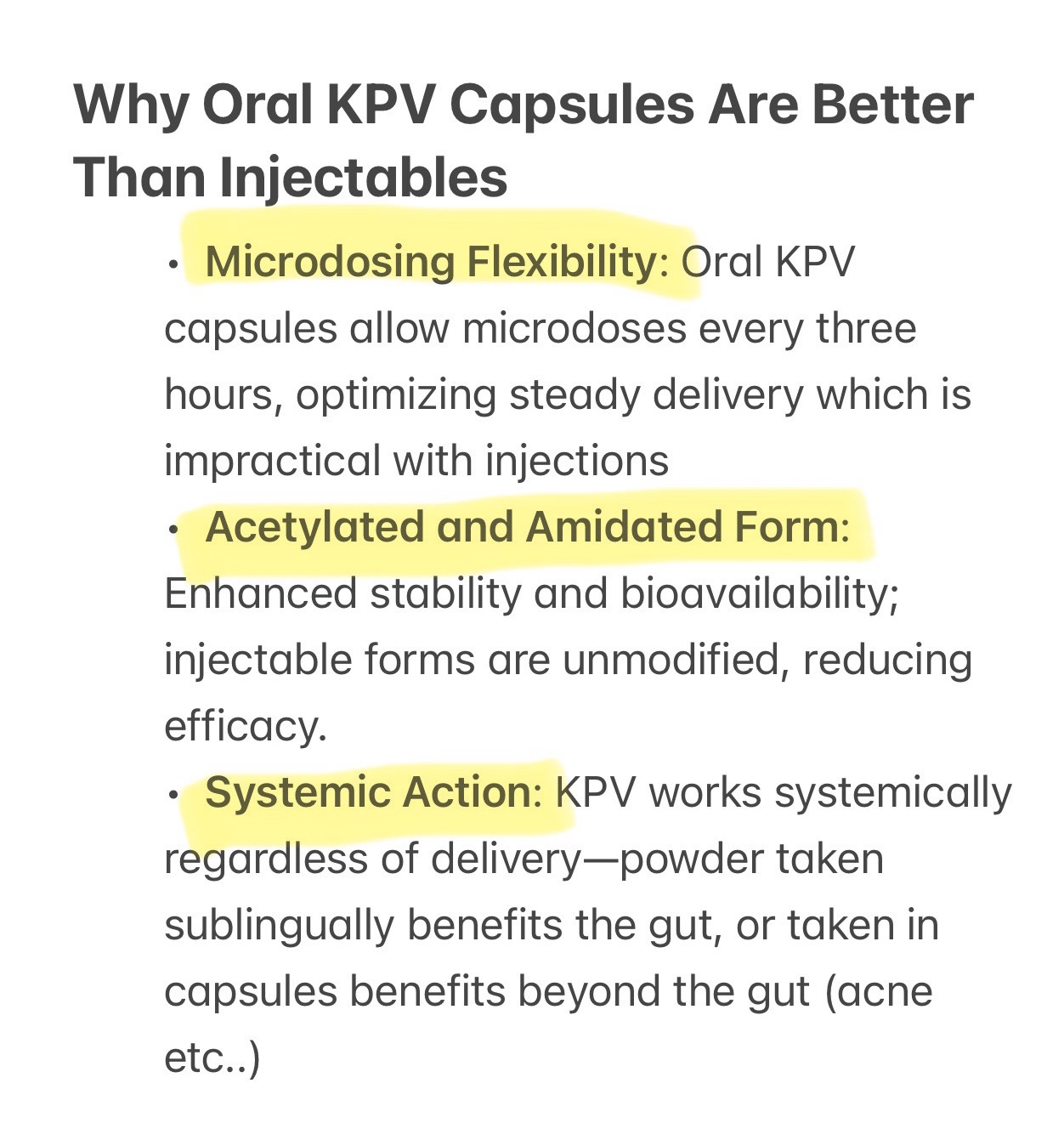
Both oral and subcutaneous routes are utilized in research protocols — with doses ranging from 200 to 500 mcg/day. Subcutaneous injections are administered once daily for all doses. Only mild local reactions and occasional temporary gastrointestinal symptoms are reported by most users when taking oral doses. Subcutaneous injections into fatty tissue are necessary for the majority of research peptides.
Skin and Wound Healing
Research protocols consistently favor subcutaneous injection for systemic anti-inflammatory effects due to predictable pharmacokinetics and patient tolerability. The peptide undergoes rapid enzymatic degradation by peptidases — contributing to its short duration of action and requiring consistent daily dosing schedules. Oral enteric-coated KPV at 500-1,000 mcg per capsule is also used for gut-specific protocols, though bioavailability is lower than subcutaneous injection.
KPV + BPC-157 is frequently mentioned by community sources as a popular combination for gut health. The best-documented routes remain oral , gut-targeted, and subcutaneous (systemic). The most frequently documented method for achieving gut-targeted effects is described by both research and community sources as oral dosing. According to community sources, oral dosing , ranging from 500 mcg to 1 mg, is preferred for achieving gut-targeted effects.
